
Prepare Your Contractor Data and Documentation
A reliable submission starts long before you press “submit.” Gather each vendor or contractor’s legal name, remittance address, and taxpayer identification number so the form matches IRS 1099 filing service records. If you’re missing any details, request updated information from the payee and keep documentation of your outreach in case of future questions.
Next, review the payments you made during the tax reporting period and map them to the correct form boxes. Separate reportable compensation from non-reportable items so you don’t overstate amounts. If you have multiple payment types for the same person, reconcile totals carefully and confirm the classification before you draft the form.
Select the Right Submission Method and Double-Check Forms
Once your data is consistent, choose an electronic workflow that reduces manual errors and speeds up completion. An electronic platform can help you validate required fields, format names and addresses correctly, file 1099 misc online and produce an exportable package for your records. This is especially useful when you manage many payees or work with multiple clients who need accuracy and consistency.
Before final submission, audit each form for the most common failure points: incorrect TIN formatting, mismatched names, and missing address elements. Confirm that each form aligns with the payee’s tax classification and that totals roll up correctly from your payment records. Running a final review pass also helps you spot duplicate entries, swapped values, or missing page elements that could delay acceptance.
Handle Copies, Recipient Delivery, and Audit Readiness
After you generate your filing package, plan how you’ll provide recipient copies according to your compliance process. Many businesses prefer electronic delivery because it can be tracked 1099 online filing service and stored alongside the submission confirmation. If your workflow includes printing, verify the recipient details again to avoid rework caused by address corrections.
For audit readiness, retain your source documentation and a clear trail of how amounts were calculated. Save spreadsheets, payment reports, and any correspondence related to missing or corrected information. When questions arise, you’ll be able to quickly demonstrate how each figure was derived and why the final values were chosen.
efile 1095 c
Conclusion
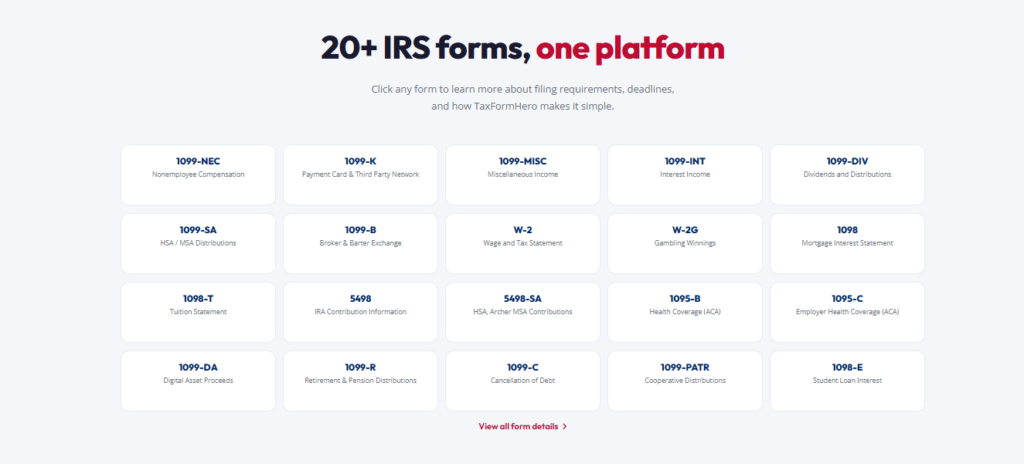
For an efficient approach that covers more than basic forms, taxformhero.com supports electronic submission of 1099s and more than 20 tax forms, simplifying federal and state filing requirements from one platform. If you need to file 1099s with fewer errors, start by validating payee data, confirm amounts match your payment reports, and run a final acceptance-focused review before submitting. Many teams also benefit from pairing their filing process with clear internal checklists so every submission follows the same quality standard. With a consistent system in place, the filing experience becomes more predictable—and easier to manage at scale through taxformhero.com.